
Cisco Nexus 3550 Series Switches
Ultra-low latency network platforms and switches
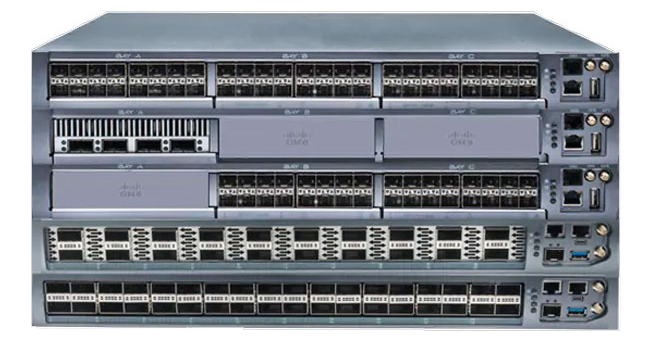
Overview:
The Nexus 3550 Series provides next generation FPGA programmable platform capabilities, high density switching, programmable multiplexing and precision timestamping to power your ultra-low latency network applications.

Ultra-low latency networking
Nexus 3550 platforms and switches are designed and optimized for ultra-low latency applications.

Software-Defined Hardware
The Nexus 3550-T platform provides the performance characteristics of hardware plus FPGA agility and programmability of software.

Modular switch architecture
The Nexus 3550-F modular architecture provides the flexibility to scale connectivity options, implement FPGA device upgrades and functionality features.

High density layer 1 switching
The Nexus 3550-H are high-density layer 1 switches for date monitoring and distribution applications.
Compare Cisco Nexus 3550 Series models
The 3550 Series provides programmable platform capabilities, fast layer 2 and 3 switching, high-speed multiplexing, precision timestamping and high-density layer 1 switching to power your ultra-low latency network applications.
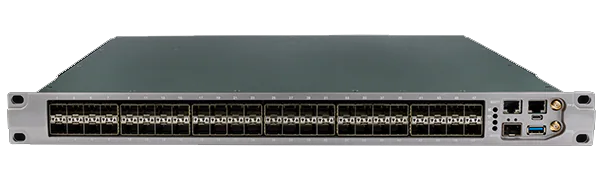
Nexus 3550-T Programmable Network Platform
Programmable 1RU switch with FPGA device for long-term enhancements, upgrades and applications
Nexus 3550-F Programmable Layer 2 Application Platform
Full MAC learning layer 2 switch with VLAN and IGMP support. Port-to-port latencies as low as 95ns.
Nexus 3550-F Programmable Multiplexer Switch
Many to one aggregation (multiplexing) with minimum latencies of 39ns port-to-port.
Nexus 3550-F High Precision Timestamping Switch
Network tap and aggregation with 70ps high-precision timestamps and 32GB deep buffers.
Nexus 3550-F Modular Layer 1 Matrix Switch
Modular ultra-low latency layer 1 switch for network tap, patch and fan-out operations.
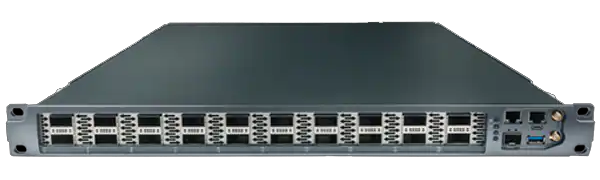
Nexus 3550-H High-density Layer 1-160 Switch
Our highest-density L1 switch for network monitoring, dynamic reconfiguration, and low-latency multicast.
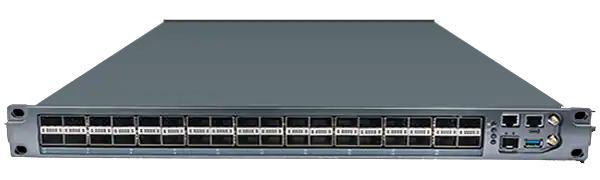
Nexus 3550-H High-density Layer 1-144 Switch
High-density L1 switch for network monitoring, dynamic reconfiguration, and low-latency multicast.
Cisco Nexus 3550-T Programmable Network Platform:
The Cisco Nexus 3550-T Programmable Network Platform is a top-of-rack software application platform with a unique low-latency design. The Cisco Nexus 3550-T Platform features up to 48 ports of Ethernet connectivity in a single-rack unit form factor. The platform is built around a powerful programmable FPGA and provides a complete firmware development environment for custom application and use cases.
Hardware architecture
The Cisco Nexus 3550-T Programmable Network Platform has a fixed form factor that is built around a dynamically reconfigurable FPGA (Field Programmable Gate Array) and provides 48 ports that are 25G capable along with an x86 (Intel® Atom® processor with 8 cores up to 1.7 GHz)–management CPU. All 48 ports are directly connected to Xilinx Virtex UltraScale Plus VU35P FPGA with a “-3” speed grade. The FPGA has 8GB of High Bandwidth Memory (HBM) on board.
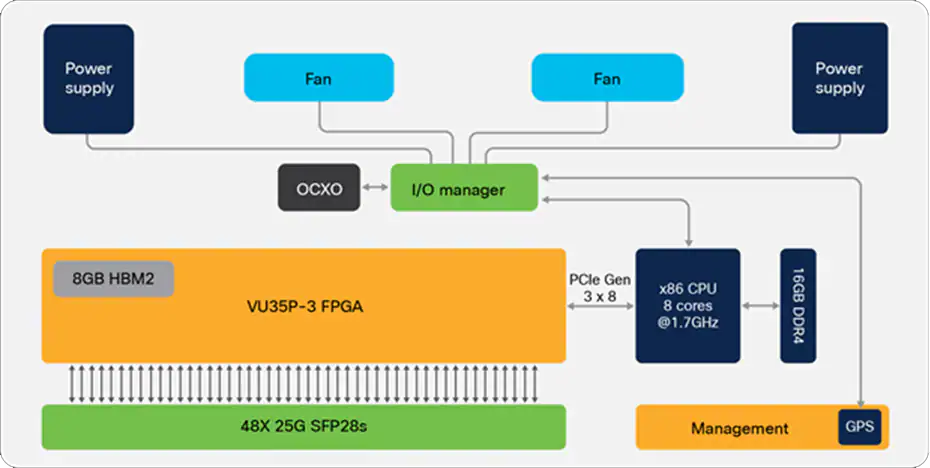
Ease of management
The Cisco Nexus 3550-T Programmable Network Platform features a console port, a Micro USB port, a 1G RJ45 port, and a 10G SFP+ port, which can be used as management interfaces. The Cisco Nexus 3550-T Platform uses a Command Line Interface (CLI) designed to address the needs of low-latency FPGA configurations. Every command available on the CLI is also available via a remote JSON RPC API to make the Nexus 3550-T easy to operate and manage at scale.
The Cisco Nexus 3550-T Programmable Network Platform includes standard enterprise manageability and deployment capability features such as automatic configuration (via DHCP), SNMP, TACACS+ authentication, on-board Python programmability, BASH shell access, and time-series logging.
Programmability
The Cisco Nexus 3550-T Programmable Network Platform provides a powerful development framework to add application-specific intelligence to the Cisco Nexus 3550 FPGA Module using Cisco’s Nexus Firmware Development Kit (FDK). Our Cisco Nexus FDK provides all the required components to build, run, and maintain FPGA-based intelligent applications and accelerate network applications.
Switch platform features
Statistics
The Cisco Nexus 3550-T Programmable Network Platform supports packet-aware statistics. The Cisco Nexus 3550-T firmware has the capability to monitor for vital packet statistics, including the number of packets/bytes transmitted/received and transmit/receive errors, and deep diagnostics, including light levels, operating temperatures, transceiver capabilities, and more. All these statistics are available at no latency cost on the critical path. The following are some of the available statistics:
- Packet counters (RX, TX)
- Current RX link state
- RX link change count
- CRC error counters for RX-temperature information
- Power-supply sensor information
- Fan speed
Connectivity
- 48 x SFP28 (small form-factor pluggable) configuration (backward compatible with SFP+ and SFP)
- SFP+ Fiber (10GBASE-SR, 10GBASE-LR, 10GBASE-LRM, 1000BASE-SX, 1000BASE-LX)
- SFP+ Copper Direct Attach
- SMA for PPS in/out* (3.3V with 50 Ohm signal interface)
- SMA for GPS* in
- RJ45 management port
- RJ45 industry-standard serial port (default speed: 115200 N81)
- USB (for firmware upgrades)
Management
- CLI via serial, SSH, and telnet
- JSON RPC API for all CLI commands
- Automatic configuration via DHCP
- TACACS+ and multiuser support
- ACL's on management interface
- FW updates via SFTP, TFTP, HTTP, and USB
- Onboard BASH and Python scripts
- Onboard Cron jobs
- Time synchronization via PPS, GPS, PTP, and NTP
General
- 19” 1RU, rack mount
- Weight 10kg (22lbs)
- Dual, hot-swappable supplies
- Standard: AC 90-264V, 47-64 Hz, included IEC C13-C14 cables
- Optional: DC 40-72V
- Maximum consumption: 150W
- Dual hot-swappable fan modules
- Optional airflow direction
- Operating temperature: -5 °C to 45 °C
- Storage temperature: -40 °C to 70 °C
- Operating Relative Humidity: 5% to 90% (noncondensing)
- Storage Relative Humidity: 5% to 95% (noncondensing)
Supported applications
The following table shows the list of currently supported and upcoming network applications for the Cisco Nexus 3550-T Programmable Network Platform. Some of these network applications are bundled within a single release. The details of these network applications can be found in the software release notes. Release notes are updated as new network applications are released.
| Application | Overview |
|---|---|
| ULL Layer 3 Routing App | Ultra-low latency Layer 3 switching capability |
| ULL Layer 2 Switching App | Ultra-low latency Layer 2 switching capability |
| Security | Enhanced packet-filtering and Network Address Translation (NAT) |
| High Availability* | Provides redundancy in the networ |
| WAN Extension* | WAN link policing |
| FastMux* | Packet-aggregation capabilit |
| Exchange Gateway App* | Ultra-low latency exchange fairness and HPT |
| Data Broker App* | Packet-flow optimization |
| Grand Master App* | Provides Grandmaster Clock |
| Tap Agg* | Provides network visibility |
| User custom applications (FDK) | Adding custom intelligence in the network. |
*Future release
Documentation:
Download the Cisco Nexus 3550-T Programmable Network Platform Datasheet (PDF).
Nexus 3550-F Programmable Layer 2 Application Platform:
The Cisco Nexus 3550-F Programmable Layer 2 Application Platform is a compact, yet powerful networking platform designed specifically for low-latency applications. The device features up to 48 ports of 10G Ethernet connectivity in a single rack unit form factor that can be programmed as:
- Fully managed Layer 2 MAC learning platform, with VLAN tagging/trunking and IGMP snooping. This is intended for applications where simple multiplexers are insufficient. As a Layer 2 Application Platform, the device offers latencies as low as 95ns.
Scalable modular architecture
The Cisco Nexus 3550-F Programmable Layer 2 Application Platform (N35-FS-48X) is built around a unique modular architecture that scales with your network. Three-line card bays provide the flexibility to grow and change connectivity options over time, while two internal module bays allow the device to be upgraded with expanded functionality, adding new capabilities and extending the useful life of the product. The 3550-F Programmable Layer 2 Application Platform architecture is shown in the figure below (Figure 1). At the heart of the architecture is High-Density Layer 1 connectivity that provides low-latency programmable 10GbE connectivity between all modules.
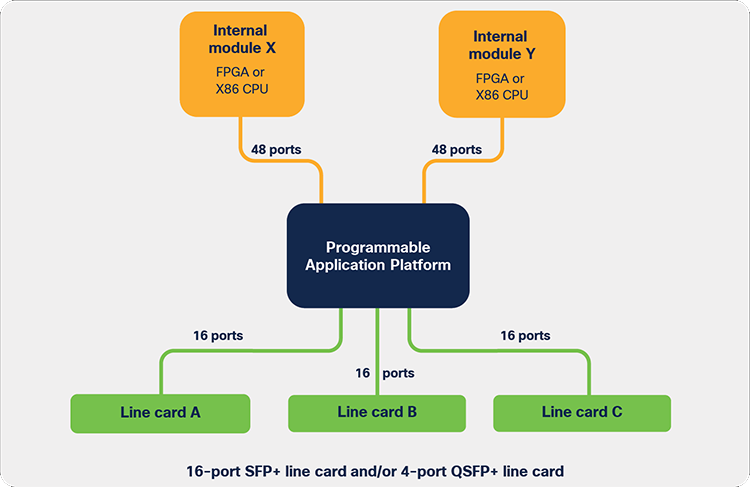
The external module bays (A, B, and C) can be populated with a 16-port SFP+ line card (N35-F-16P) and/or a 4-port QSFP+ line card (N35-F-4Q). Standard SFP+ and QSFP+ optics or cable connectivity options are available.
A high-density FPGA (N35-F-KU115) module is included for Layer 2 applications. For custom applications, multiple FPGAs and/or multiple X86 CPU modules (N35-F-SKL) may be installed and programmed.
Ease of use and manageability
The Cisco Nexus 3550-F Programmable Layer 2 Application Platform runs a custom operating system and Command Line Interface (CLI), designed specifically to address the needs of Layer 2 and low-latency FPGA applications. Every command available on the CLI is also available through a remote JSON RPC API. This makes the device easy to operate and manage at scale.
The Cisco Nexus 3550-F Programmable Layer 2 Application Platform includes standard enterprise manageability and deployment features including automatic configurations (through DHCP), SNMP, TACACS+ authentication, on-board Python programmability, BASH shell access, and time-series logging.
Packet aware statistics and monitoring
The Cisco Nexus 3550-F Programmable Layer 2 Application Platform is fully packet aware. Every port on the device is monitored for vital packet statistics, including the number of packets and bytes transmitted or received and transmit and receive errors. The device also provides deep diagnostics, including light levels, operating temperatures, transceiver capabilities, and more. All these statistics are available at no latency cost on the critical path.
Layer 2 learning application capabilities
Not all use cases need Layer 1 learning or Layer 2 Multiplexing. Sometimes a Layer 2 learning platform is needed, yet low latency is still required. Along with the capability to run Layer 1 learning applications and Multiplexing applications, the 3550-F Programmable Layer 2 Application Platform provides Layer 2 learning applications with a latency as low as 95ns, which is almost half the latency of the previous generation Layer 2 devices. In addition to MAC learning, it also offers:
- VLAN tagging, trunking, stripping, and rewriting
- IGMP snooping
- TAP/agg timestamping with 2.8ns timestamp resolution
- BGP client (peering only)
Switch platform features
Latency
- L1 Tap/Patch: 3ns minimum – 5ns maximum
- FastMux: 39ns minimum – 48ns maximum
- Mux: 92ns minimum – 107ns maximum
- Mux (switch): 86ns minimum – 102ns maximum
- Layer 2 Application: 95ns minimum – 126ns maximum
Statistics
- Packet counters (RX, TX, dropped, etc.)
- Per port status LEDs
- Live packet dump
- SFP diagnostics (light levels, temps, etc.)
- SNMP, local, and remote syslog
- Time-series logging to InfluxDB
Connectivity
- 3x 16 SFP+ line cards, up to 48 ports
- 3x 4QSFP line cards, up to 12 ports (48x10G)
- SFP+ Fiber (10GBASE-SR, 10GBASE-LR, 10GBASE-LRM, 1000BASE-SX, 1000BASE-LX)
- SFP+ copper direct attach
- SMA for PPS in/out
- SMA for GPS in
- RJ45 management port
- RJ45 Industry standard serial port
- USB (for firmware upgrades)
Management
- CLI via serial, SSH, and telnet
- JSON RPC API for all CLI commands
- Automatic configuration via DHCP
- TACACS+ and multiuser support
- ACLs on management interface
- FW updates via SFTP, TFTP, HTTP, and USB
- Onboard BASH and Python scripts
- Onboard Cron jobs
- Time sync via PPS, GPS, PTP, and NTP
General
- 19” 1RU, rack mount
- Weight 11kg (24lbs)
- Dual, hot-swappable supplies
- Standard: AC 90-264V, 47-64 Hz, included IEC C13-C14 cables
- Optional: DC 40-72V
- Maximum consumption: 150W
- Dual hot-swappable fan modules
- Optional airflow direction
- Operating temperature: -5 °C to 45 °C
- Storage temperature: -40 °C to 70 °C
- Operating Relative Humidity: 5% to 90% (noncondensing)
- Storage Relative Humidity: 5% to 95% (noncondensing)
Documentation:
Download the Cisco Nexus 3550-F Programmable Layer 2 Application Platform Datasheet (PDF).
Cisco Nexus 3550-F Modular L1 Matrix Switch and Programmable Multiplexer Switch:
The Cisco Nexus 3550-F products are a compact yet powerful networking platform designed specifically for low-latency applications. The Nexus 3550-F products feature up to 48 ports of 10G Ethernet connectivity in a single-rack-unit form factor that can be configured as follows:
- Cisco Nexus 3550-F Modular Layer 1 Matrix Switch is purpose-built for low-latency data fan-out, electronic patch panels, and transparent monitoring applications. Layer 1 switching offers port-to-port latencies under 5ns.
- Cisco Nexus 3550-F Programmable Multiplexer Switch is designed to support multiple multiplexing modes for many-to-one aggregation use cases. Applications include low-latency link aggregation for financial trading order entry networks and low-latency telecommunications networks. This mode offers latencies as low as 39ns.
Scalable modular architecture
The Cisco Nexus 3550-F products are built with a unique modular architecture that scales with your network. Three-line card bays provide the flexibility to grow and change connectivity options over time, while two internal module bays allow the device to be upgraded with expanded functionality, adding new capabilities and extending the useful life of the product. The 3550-F architecture is shown in the figure below (Figure 1). At the heart of the architecture is a high-density Layer 1 matrix switch. This matrix switch provides low-latency programmable 10GbE connectivity between all modules.
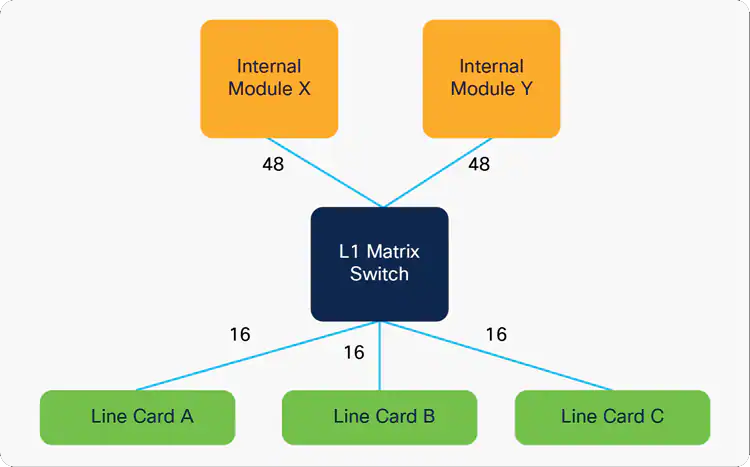
The external module bays (A, B, and C) can be populated with a 16-port SFP+ line card (N35-F-16P) and/or a 4-port QSFP+ line card (N35-F-4Q). Standard SFP+ and QSFP+ optics or cable connectivity options are available.
The internal modules bays are unpopulated for Layer 1 only use. A high-density FPGA (N35-F-KU115) module is included for Layer 2 Mux application. For custom applications, multiple FPGAs and/or multiple X86 CPU modules (N35-F-SKL) can be installed and programmed.
Cisco Nexus 3550-F Modular Layer 1 Matrix Switch
Unlike traditional network switches that operate only at the data-link layer (Layer 2), the Cisco Nexus 3550-F Modular Layer 1 Matrix Switch can operate at the physical network Layer 1 to provide the benefits of circuit switching to Ethernet devices. Connections through the switch are programmed into a matrix switch (see Figure 2) ahead of time and remain configured indefinitely. Unlike dynamic packet-based switching, this has the advantage of providing very low and deterministic latency. Packets can cross a Layer 1 matrix switch in under 5ns (from port to port).
The Cisco Nexus 3550-F Modular Layer 1 Matrix Switch has several useful purposes. It allows the device to tap into connections (for near transparent network monitoring), to patch connections between ports (for electronic network reconfiguration) and to fan-out connections from one port to many (for low latency data replication applications).
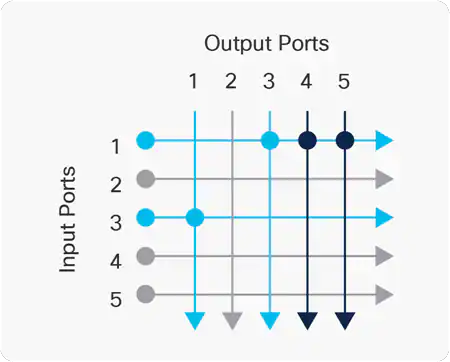
Illustrates an example configuration of a Layer 1 matrix switch:
- A “patch” is configured between ports 1 and 3: all traffic from port 1 is directed to port 3, all traffic from port 3 is directed to port 1. This patch can be
- Two “taps” are configured from port 1 to ports 4 and 5: traffic from port 1 is replicated to ports 4 and 5 at latencies as low as 2.8ns. Typically, such low latencies would be viewed as transparent to other network devices.
Transparent tapping
Network monitoring is vital for logging, debugging and compliance. While optical taps can be used for low latency network inspection, they consume valuable rack space and cannot be remotely managed. The Cisco Nexus 3550-F Modular Layer 1 Matrix Switch replaces 16 optical taps (48 ports) in a single 1RU device. Taps through the Cisco Nexus 3550-F Modular Layer 1 Matrix Switch employ active signal regeneration so that the signal quality remains high while port-to-port latencies are as low.
An electronic patch panel
Network reconfiguration is a fact of life, yet colocation access is often expensive and sometimes impossible (for example, during business hours). The Cisco Nexus 3550-F Modular Layer 1 Matrix Switch offers a fast and convenient tool for managing and reconfiguring a physical network, remotely and at any time of the day, yet adds nearly no overhead. The remote JSON RPC API allows for such changes to be simply automated and controlled by a logically central controller.
Packet-aware statistics and monitoring
Although the Cisco Nexus 3550-F Modular Layer 1 Matrix Switch operates at the physical layer, it is fully packet aware. Every port on the device is monitored for vital packet statistics including the number of packets/bytes transmitted/received and transmit/receive errors. The device also provides deep diagnostics including light levels, operating temperatures, transceiver capabilities, and more. All these statistics are available at no latency cost on the critical path.
Cisco Nexus 3550-F Programmable Multiplexer Switch
The Cisco Nexus 3550-F Programmable Multiplexer Switch offers specialized multiplexing/demultiplexing features designed for low-latency applications and telecommunication networks. In the absence of queueing, packets can cross the device in as little as 39ns. This makes the Cisco Nexus 3550-F Programmable Multiplexer Switch one of the fastest multiplexers available in the market.
The Cisco Nexus 3550-F Programmable Multiplexer Switch is superior to typical Ethernet network switches when you need to support low-latency applications, electronic trading networks, and low-latency telecommunication networks. These specialized networks require n-to-1 link aggregation (multiplexing) and 1-to-n link disaggregation (demultiplexing). Ethernet network switches can only perform all-to-all switching, which is slow and expensive for n-to-1 multiplexing and 1-to-n demultiplexing.
Different multiplexers for different requirements
Multiplexing may seem simple in principle, but there are many tradeoffs depending on the use case: What line speeds are required? How many ports are needed? How deep should buffers be for contention? What type of demultiplexing is supported? The Cisco Nexus 3550-F Programmable Multiplexer Switch supports multiple multiplexing modes, each with a different feature and latency tradeoffs, summarized in Table 1.
| Mode | Latency (min) | Link rate(s) | Total muxes | Max ports | Buffer per port | Demuxing |
|---|---|---|---|---|---|---|
| FastMux | 39ns | 10GbE | 4 | 15,11,11,1 | 4kB | L1 only |
| Mux | 92ns | 1/10GbE | 4 | 48 | 20kB | L1/L2/VLAN |
The FastMux mode, is the fastest multiplexer available. It offers 10G Ethernet connectivity and limited buffer depth. Demultiplexing is performed by layer 1 broadcast only. The FastMux is designed for applications where contention is low and pure speed is the only objective, such as electronic trading order entry networks.
The Mux mode offers 1G and 10G Ethernet options, with the ability to rate convert between these rates. It also offers Layer 2 and VLAN based demultiplexing. These features are designed for low latency long range wireless telecommunication networks where many customers require access to the same low-speed radio link.
Cisco Nexus 3550-F L1 Switch and Nexus 3550-F Mux feature comparison
The modularity of the Cisco Nexus 3550-F L1 Switch and Nexus 3550-F Mux can be purchased in multiple configurations. Table 2 lists the feature matrix for each configuration.
| Mode | Layer 1 switching | Layer 2 muxing | Layer 2 switching | Ordering ID |
|---|---|---|---|---|
| Cisco Nexus 3550-F Fusion L1 | 39ns | 10GbE | 4 | 15,11,11,1 |
| Cisco Nexus 3550-F Fusion Mux | 92ns | 1/10GbE | 4 | 48 |
Cisco Nexus 3550-F L1 Switch and Nexus 3550-F Mux product features
Latency
- L1 Tap/Patch: 3ns minimum – 5ns maximum
- FastMux: 39ns minimum – 48ns maximum
- Mux: 92ns minimum – 107ns maximum
- Mux (switch): 86ns minimum – 102ns maximum
Statistics
- Packet counters (RX, TX, dropped, etc.)
- Per port status LEDs
- Live packet dump
- SFP diagnostics (light levels, temps, etc.)
- SNMP, local, and remote syslog
- Time-series logging to InfluxDB
Connectivity
- 3x 16 SFP+ line cards, up to 48 ports
- 3x 4QSFP line cards, up to 12 ports (48x10G)
- SFP+ Fiber (10GBASE-SR, 10GBASE-LR, 10GBASE-LRM, 1000BASE-SX, 1000BASE-LX)
- SFP+ copper direct attach
- SMA for PPS in/out
- SMA for GPS in
- RJ45 management port
- RJ45 Industry standard serial port
- USB (for firmware upgrades)
Management
- CLI via serial, SSH, and telnet
- JSON RPC API for all CLI commands
- Automatic configuration via DHCP
- TACACS+ and multiuser support
- ACLs on management interface
- FW updates via SFTP, TFTP, HTTP, and USB
- Onboard BASH and Python scripts
- Onboard Cron jobs
- Time sync via PPS, GPS, PTP, and NTP
General
- 19” 1RU, rack mount
- Weight 11kg (24lbs)
- Dual, hot-swappable supplies
- Standard: AC 90-264V, 47-64 Hz, included IEC C13-C14 cables
- Optional: DC 40-72V
- Maximum consumption: 150W
- Dual hot-swappable fan modules
- Optional airflow direction
- Operating temperature: -5 °C to 45 °C
- Storage temperature: -40 °C to 70 °C
- Operating Relative Humidity: 5% to 90% (noncondensing)
- Storage Relative Humidity: 5% to 95% (noncondensing)
Documentation:
Download the Cisco Nexus 3550-F Modular L1 Matrix Switch and Programmable Multiplexer Switch Datasheet (PDF).
Cisco Nexus 3550-F High Precision Timestamping Switch:
The Cisco Nexus 3550-F High Precision Timestamping Switch is a network tapping, aggregation, and monitoring solution, optimized for high-performance, low-latency networks. The device incorporates Cisco’ industry-leading HPT1 time-stamping technology, for 70-picosecond (70ps) timestamps that are embedded in every packet. This makes the Cisco Nexus 3550-F HPT the highest-precision network aggregation and monitoring solution available on the market today. The switch also offers high-quality time synchronization to pulse-per-second (PPS), GPS, and Precision Time Protocol (PTP) sources, ensuring that every packet is globally synchronized as well as precisely timestamped.

High-bandwidth ingress and egress
The system offers 400Gb/s of ingress and configurable egress options of up to 80Gb/s. The Cisco Nexus 3550-F HPT ensures that tap aggregation performs well under adverse network conditions. The switch supports up to 40 ingress ports operating at 1Gb/s2, 10Gb/s, or 40Gb/s2 (400Gb/s total), with HPT timestamps at 70ps resolution. Egress is supported through between 1 and 8 ports operating at 10Gb/s each, or 1 to 2 ports operating at 40Gb/s2 each. Egress ports also feature industry-standard Ethernet flow control, to allow lossless transmission even when capture devices are congested.
Deep packet buffer hierarchy
A deep, multilayered packet buffer architecture provides robust micro-burst protection. Correlated micro-bursts are a fact of life, especially in high-performance networks. Yet regulatory environments require that every packet be captured. The Cisco Nexus 3550-F HPT has a deep packet buffer hierarchy to ensure that packets are captured, time stamped, and transferred to long-term storage, even under extreme correlated micro-burst scenarios. The switch provides 32kB per-port buffers, 64kB per-quad-port buffers, and 32GB of global packet buffering (see figure overleaf). This multilayer architecture makes the Cisco Nexus 3550-F HPT the most reliable tap aggregation system available today.
Transparent tapping
Replace 20 optical taps with a single 1RU device
Optical taps are difficult to deploy and manage, and consume large amounts of rack space. Every ingress port on the Cisco Nexus 3550-F HPT can be configured as a Layer 1 tap, allowing the switch to replace 20 optical taps in a single 1RU of rack space. Cisco Nexus 3550-F HPT taps are transparent to other devices. They add less than 5ns of delay to the tapped path, and nearly undetectable jitter.
Ease of use and manageability
Ease of use and enterprise manageability features are core to the Cisco Nexus 3550-F HPT. Many users rate our CLI (Command Line Interface) as one of the best they have used. Every command available on the CLI is also available via a remote JSON RPC API. This makes the switch easy to operate and to manage at scale. All Cisco Nexus 3550-F platforms and switches include standard enterprise manageability and deployability features, including automatic configuration (via DHCP), SNMP, TACACS+ authentication, onboard Python programmability, BASH shell access, and time-series logging.
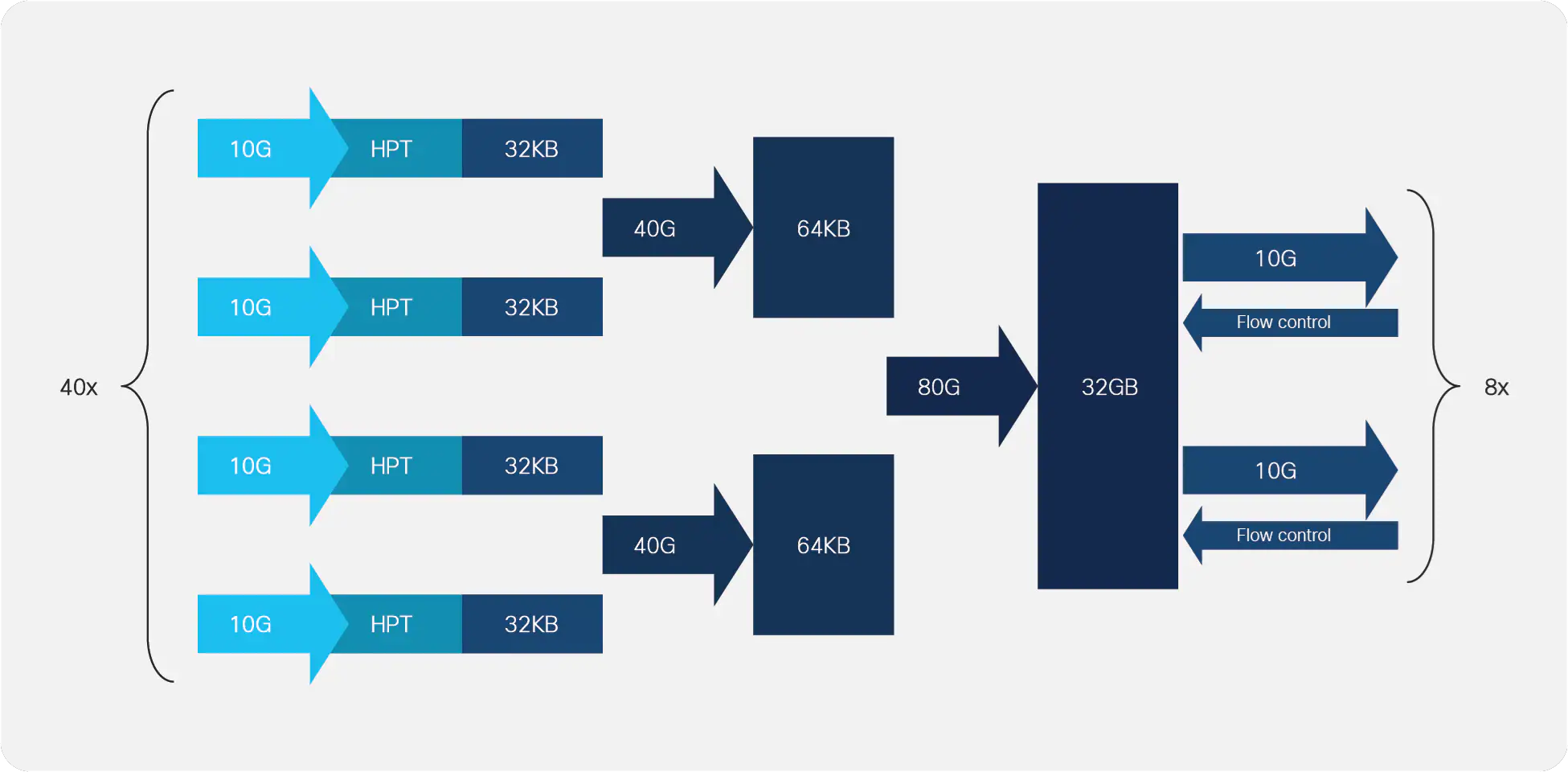
Cisco Nexus 3550-F HPT multilayer, deep packet buffer hierarchy
Aggregation
- 400Gb/s ingress (1GbE2/ 10GbE/40GbE2)
- 70ps high-precision timestamping (HPT1)
- 80Gb/s egress (8x 10GE or 2x 402GbE) with Ethernet flow control (IEEE 802.3x)
Packet buffering
- 32kB per port buffer (40x)
- 64kB per quad port buffer (10x)
- 32GB deep buffer (shared)
Time synchronization
- 72 channel GPS, GLONASS, QZSS, BeiDou
- Active antenna support (3.3V)
- Cold-start timesync acquisition <30s< /li>
- PPS in/out with selectable 50Ω termination
- PTP/NTP support via management port
Connectivity
- 3x 16 SFP+ line cards, up to 48 ports
- 3x 4QSFP line cards, up to 12 ports
- Any 40 ports assignable as ingress
- Any 8 ports assignable as egress
- SFP+ Fiber (10GBASE-SR, 10GBASE-LR, 10GBASE-LRM, 1000BASE-SX, 1000BASE-LX)
- SFP+ Copper Direct Attach
- SMA for PPS in/out
- SMA for GPS in
- RJ45 management port
- RJ45 industry-standard serial port
- USB (for firmware upgrades)
Management
- CLI via serial, SSH, and telnet
- JSON RPC API for all CLI commands
- Automatic configuration via DHCP
- TACACS+ and multiuser support
- ACLs on management interface
- Firmware updates via SFTP, TFTP, HTTP, and USB
- Onboard BASH and Python scripts
- Onboard Cron jobs
Statistics
- Packet counters (RX, TX, dropped, etc.)
- Per port status LEDs
- Live packet dump
- SFP diagnostics (light levels, temps, etc.)
- SNMP, local, and remote syslog
- Time-series logging to InfluxDB
General
- 19” 1RU, rack mount
- Weight: 11kg (24lbs)
- Dual, hot-swappable supplies
- Standard: AC 100-240 Vac, 50-60 Hz
- Optional: DC 48-60 Vdc
- Maximum consumption: 150W
- Dual hot-swappable fan modules
- Optional airflow direction (FTB, BTF)
- Operating temperature: -5 °C to 45 °C
- Storage temperature: -40 °C to 70 °C
- Operating Relative Humidity: 5% to 90% (non-condensing)
- Storage Relative Humidity: 5% to 95% (non-condensing)
- Max Operating Altitude: 3048m (Mainland China: 2000m)
- Class I Equipment
Download the Cisco Nexus 3550-F High Precision Timestamping Switch Datasheet (PDF).
Cisco Nexus 3550-H High-density Layer 1 Switch:
The Cisco Nexus 3550-H High-density Layer 1 Switch is purpose-built and optimized for enterprise network monitoring, patch and fanout connections to support high-speed applications.
The Cisco Nexus 3550-H High-density Layer 1 Switch is unlike traditional network switches that operate at the data-link layer (Layer 2), the Cisco Nexus 3550-H operates at the physical network layer (Layer 1). Connections through the switch are made electrically through a matrix switch (see figure 3). This allows the switch to tap into connections (for network monitoring), patch connections between ports (for reconfiguration), and fanout connections from one port to many (for high-speed applications), at nearly zero latency (<5ns).< /p>
Cisco Nexus 3550-H High-density Layer 1-144 Switch
Cisco Nexus 3550-H High-density Layer 1-160 Switch
Introducing QSFP-DD
Cisco Nexus 3550-H High-density Layer 1 Switch
The Cisco Nexus 3550-H (160) is the first networking switch to use double-density QSFP-DD connectors. QSFP-DD connectors are 100 percent backward compatible with legacy QSFP connectors, enabling a smooth transition path from legacy network cabling/connectors to QSFP-DD high-density connectors. The Cisco Nexus 3550-H is also available in a QSFP-only option.
All-new management platform
Enterprise manageability features are core to the Cisco Nexus 3550-H.
The Cisco Nexus 3550-H features an all-new management platform based on the Nexus 3550-F Modular Layer 1 Matrix Switch.
The Cisco Nexus 3550-H features a powerful x86-based management CPU, dual (1G and 10G) Ethernet management interfaces, USB and RS232-based console access, and 10Gbps access from the management CPU to the data plane. It also offers high-quality PPS and GPS-based time synchronization options for inline packet timestamping.
Packet-aware statistics and monitoring
The Cisco Nexus 3550-H operates at the physical layer and is fully packet aware.
Every port on the Cisco Nexus 3550-H is monitored for vital packet statistics, including the number of packets/bytes transmitted/received, and transmit/receive errors. The switch also provides deep diagnostics on each of its 20 QSFP-DD ports including light levels, operating temperatures, transceiver capabilities, and more. All of these statistics are available at no latency cost on the critical path.
Transparent tapping
Replace 53 optical taps in a single 1RU switch
Network monitoring is vital for logging, debugging, and compliance. While optical taps can be used for low latency network inspection, they consume valuable rack space and cannot be remotely managed. The Cisco Nexus 3550-H replaces 53 optical taps (159 lanes) in a single 1RU switch. Taps through the 3550-H employ active signal regeneration so that the signal quality remains high while port-to-port latencies are as low as 3.2ns with nearly undetectable jitter. This makes it nearly transparent to other infrastructure devices in your network.
The Cisco Nexus 3550-H. A patch is configured between ports 1 and 3: all traffic from port 1 is directed to port 3, all traffic from port 3 is directed to port 1. Taps are configured from port 1 to ports 4 and 5: traffic from port 1 is replicated to ports 4 and 5 at latencies as low as 3.2ns.
Cisco Nexus 3550-H port matrix
Cisco Nexus 3550-H High-density Layer 1 Switch product features
Latency
- Tap, patch, and fanout. 1:1 and 1:N connectivity on all ports
- 3.2ns (min) port latency
- 1G/10Gb/s connectivity on all ports
- I/O signal conditioning and regeneration
Statistics
- Packet counters (RX, TX, dropped, etc.)
- Per port status LEDs
- tcpdump all ports
- QSFP(-DD) diagnostics (light levels, temps, etc.)
- SNMP, local, and remote syslog
- LLDP TX/RX
- Time-series logging to InfluxDB
Connectivity
- 20 QSFP-DD ports, 160x 10G lanes (Cisco Nexus 3550-H Hydra 160) or 36 QSFP ports, for 144x 10G lanes (Cisco Nexus 3550-H Hydra 144)
- QSFP (-DD) 8x [10GBASE-SR, 10GBASE-LR, 10GBASE-LRM, 1000BASE-SX, 1000BASE-LX]
- QSFP (-DD) Copper Direct Attach
- RJ45/SFP+ management ports (1G/10G)
- RJ45 Industry standard serial port
- USB Micro serial port
- USB (for firmware upgrades)
- 2x SMA for GPS and PPS
Management
- x86-based management CPU
- CLI via serial, SSH, and telnet
- JSON RPC API for all CLI commands
- Automatic configuration via DHCP
- TACACS+ and multiuser support
- ACLs on management interface
- FW updates via SFTP, TFTP, HTTP and USB
- Onboard BASH and Python scripts
- Onboard Cron jobs
- Time sync via PPS, GPS, PTP and NTP, Low latency tapping, patching, and fan-out
General
- 19” 1RU, rack mount
- Weight: 15kg (24lbs)
- Dual, hot-swappable supplies
- Standard: AC 100-240 Vac, 50-60 Hz
- Optional: DC 40-72Vdc
- Maximum consumption: 750W
- 3 hot-swappable fan modules
- Optional airflow direction (FTB, BTF)
- Operating temperature: -5 °C to 45 °C
- Storage temperature: -40 °C to 70 °C
- Operating Relative Humidity: 5% to 90% (noncondensing)
- Storage Relative Humidity: 5% to 95% (noncondensing)
- Max Operarting Altitude AC: 5000m
- Max Operating Altitude DC: 3048m (Mainland China 2000m)
- Class I Equipment
Documentation:
Download the Cisco Nexus 3550-H High-density Layer 1 Switch Datasheet (PDF).
Pricing Notes:
- Pricing and product availability subject to change without notice.