
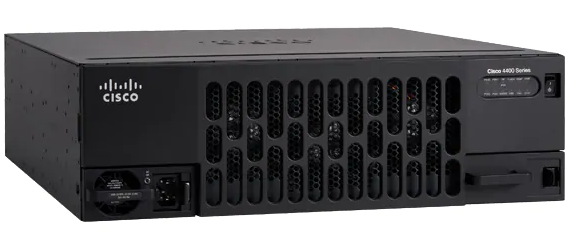
Cisco Integrated Services Router 4461
Build your digital branch
Overview:
Build your digital branch
The Cisco 4000 Series Integrated Services Routers provide routing, hosting, security, and switching--all in a single, trustworthy platform. Build your digital branch to be secure, fast, and scalable. Quickly adopt the latest technologies, from SD-WAN to edge computing, while meeting the explosive network-performance needs driven by cloud applications and digital transformation.
The Cisco 4000 Family Integrated Services Router (ISR) revolutionizes WAN communications in the enterprise branch. With new levels of built-in intelligent network capabilities and convergence, it specifically addresses the growing need for application-aware networking in distributed enterprise sites. These locations tend to have lean IT resources. But they often also have a growing need for direct communication with both private data centers and public clouds across diverse links, including Multiprotocol Label Switching (MPLS) VPNs and the Internet.
Features & Benefits:

Predictable performance
Get a high-availability architecture designed for mission-critical branches. The ISR 4000 delivers high-speed, predictable performance and modularity to connect from most remote locations.

Network services
Deploy key integrated network services for your branch in minutes, virtually or on-premises, without sacrificing performance.

Simplified management
Configure and monitor your network and enforce business policies through Cisco DNA Center and Cisco SD-WAN. Simplify network automation and turn hours of work into minutes.

Threat protection
Protect your branch site across the LAN and WAN and in the cloud with security integrated into the router. You no longer need a separate security appliance.
Cisco 4000 Family ISRs provide you with Cisco® Software Defined WAN (SDWAN) software features and a converged branch infrastructure. Along with superior throughput, these capabilities form the building blocks of next-generation branch-office WAN solutions.
Cisco Software Defined WAN
Cisco SDWAN is a set of intelligent software services that allow you to reliably and securely connect users, devices, and branch office locations across a diverse set of WAN transport links. SDWAN-enabled routers like the ISR 4000 dynamically route traffic across the “best” link based on up-to-the-minute application and network conditions for great application experiences. You get tight control over application performance, bandwidth usage, data privacy, and availability of your WAN links - control that you need as your branches conduct greater volumes of mission-critical business.
Cisco Converged Branch Infrastructure
The Cisco 4000 Series ISRs consolidate many must-have IT functions, including network, compute, and storage resources. The high-performance, integrated routers run multiple concurrent services, including encryption, traffic management, and WAN optimization, without slowing your data throughput. And you can activate new services on demand through a simple licensing change.
Cisco Intent Based Networking and Digital Network Architecture (Cisco DNA)
The Cisco Digital Network Architecture (Cisco DNA) is an open, extensible, software-driven architecture that provides for faster innovation, helping to generate deeper insights, and deliver exceptional experiences across many different applications. Cisco DNA relies on intent-based networking, a revolutionary approach in networking that helps organizations automate, simplify, and secure the network.
The intent-based Cisco DNA network is:
- Informed by Context: Interprets every byte of data that flows across it, resulting in better security, more customized experiences, and faster operations.
- Powered by Intent: Translates your intent into the right network configuration, making it possible to manage and provision multiple devices and things in minutes.
- Driven by Intuition: Continually learns from the massive amounts of data flowing through it and turns that data into actionable insight. Helps you solve issues before they become problems and learn from every incident.
Cisco DNA Center provides a centralized management dashboard across your entire network — the branch, campus, data center, and cloud. Rather than relying on box-by-box management, you can design, provision, and set policy end-to-end from the single Cisco DNA Center interface. This allows you to respond to organizational needs faster and to simplify day-to-day operations. Cisco DNA Analytics and Assurance and Cisco Network Data Platform (NDP) help you get the most from your network by continuously collecting and putting insights into action. Cisco DNA is open, extensible, and programmable at every layer. It integrates Cisco and third-party technology, open APIs, and a developer platform, to support a rich ecosystem of network-enabled applications.
Table1: Cisco 4000 Family ISR General Feature Highlights
| Business Requirement(s) | Feature/Solution |
|---|---|
Performance
|
|
| Lower WAN expenditures |
|
Pay-as-you-grow
|
|
| Superior and secure user application experiences |
|
| IT consolidation, space savings, and improved Total Cost of Ownership (TCO) |
|
| Business continuity and increased resiliency |
|
| Lower telephony costs with VoIP and rich media experiences |
|
| Easier manageability and support |
|
Technical Specifications:
Specifications of Cisco 4000 Family Integrated Services Routers
| Technical Specifications | Cisco 4461 | Cisco 4431 | Cisco 4331 | Cisco 4221 |
|---|---|---|---|---|
| Aggregate Throughput (Default) | 1.5Gbps | 500 Mbps | 100 Mbps | 35Mbps |
| Aggregate Throughput (Performance License) | 3Gbps | 1Gbps | 300 Mbps | 75 Mbps |
| Aggregate CEF Only1 Throughput (Boost License) | Over 7Gbps | Over 4Gbps | Over 2Gbps | 1.2Gbps |
| Total onboard WAN or LAN 10/100/1000 ports | 4 | 4 | 3 | 2 |
| Total onboard WAN or LAN 10Gbps ports | 2 | — | — | — |
| RJ-45-based ports | 4 | 4 | 2 | 2 |
| SFP-based ports | 4 | 4 | 2 | 1 |
| Enhanced service-module slots | 3 | 0 | 1 | 0 |
| Doublewide service-module slots | 2 | 0 | 0 | 0 |
| NIM slots | 3 | 3 | 2 | 2 |
| OIR (all I/O modules) | Yes | Yes | Yes | No |
| Onboard ISC slot | 1 | 1 | 1 | No |
| Default memory double-data-rate 3 (DDR3) errorcorrection-code (ECC) DRAM (Combined control/services/d ata planes) | NA | NA | 4GB | 4GB |
| Maximum memory DDR3 ECC DRAM (Combined control/services/d ata planes) | NA | NA | 16GB | 4GB |
| Default memory DDR3 ECC DRAM (data plane) | 4 GB | 2 GB | NA | NA |
| Maximum memory DDR3 ECC DRAM (data plane) | 4 GB | 2 GB | NA | NA |
| Default memory DDR3 ECC DRAM (control/services plane) | 8 GB | 4 GB | NA | NA |
| Maximum memory DDR3 ECC DRAM (control/services plane) | 32 GB | 16 GB | NA | NA |
| Default flash memory | 8 GB | 8 GB | 4 GB | 8 GB |
| Maximum flash memory | 32 GB | 32 GB | 16 GB | 8 GB |
| External USB 2.0 slots (type A) | 2 | 2 | 1 | 1 |
| USB console port -type B mini (up to 115.2 kbps) | 1 | 1 | 1 | 0 |
| Serial console port - RJ45 (up to 115.2 kbps) | 1 | 1 | 1 | 1 (combo CON/AUX port) |
| Serial auxiliary port - RJ45 (up to 115.2 kbps) | 1 | 1 | 1 | 1 (combo CON/AUX port) |
| Power-supply options | Internal: AC, DC and PoE | Internal: AC, DC and PoE | Internal: AC, DC, and PoE | External AC only |
| Redundant power supply | Internal: AC, DC and PoE | Internal: AC, DC and PoE | N/A | N/A |
| Power Specifications | ||||
| AC input voltage | 100 to 240 VAC autoranging | 100 to 240 VAC autoranging | 100 to 240 VAC autoranging | 100 to 240 VAC autoranging |
| DC Input Voltage Input Voltage Input Current |
48 – 60V 12A Max |
48 – 60V 12A Max |
24 – 60V 14 - 5A |
NA NA |
| AC input frequency | 47 to 63 Hz | 47 to 63 Hz | 47 to 63 Hz | 47 to 63 Hz |
| AC input current range, AC power supply (maximum) | 7.1 to 3.0A | 3 to 1.3A | 3 to 1.3A | 1.5 to 0.6A |
| Sizes and Weights | ||||
| Dimensions (H x W x D) | 3.5 x 17.25 x 18.5 in 88.9 x 438.15 x 469.9 mm) |
1.73 x 17.25 x 19.97 in (43.9 x 438.15 x 507.2 mm) |
1.75 x 17.25 x 17.25 in (44.45 x 438.15 x 438.15 mm) |
1.72 x 12.7 x 10 in (43.7 x 322.6 x 254 mm) |
| Wall-mount | No | Yes | Yes | Yes |
| Typical weight (fully loaded with modules) | 22.4 lb (10.2 kg) | 16.1 lb (7.3 kg) | 8.11 lb (3.68kg) | |
| MTBF (Hours) | 480770 | 512970 | 587250 | 593270 |
| Environmental Specifications | ||||
| Operating Conditions | ||||
| Temperature | 32 to 104ºF (0 to 40ºC) | 32 to 104ºF (0 to 40ºC) | 32 to 104ºF (0 to 40ºC) | 32 to 104ºF (0 to 40ºC) |
| Relative humidity | 5% to 85% | 5% to 85% | 5% to 85% | 5% to 85% |
| Nonoperating Conditions | ||||
| Temperature | -40 to 158ºF (-40 to 70ºC) |
-40 to 158ºF (-40 to 70ºC) |
-40 to 158ºF (-40 to 70ºC) |
-40 to 158ºF (-40 to 70ºC) |
| Relative humidity | 5% to 95% | 5% to 95% | 5% to 95% | 5% to 95% |
| Cisco IOS XE Software | ||||
| Protocols | IPv4, IPv6, static routes, Routing Information Protocol Versions 1 and 2 (RIP and RIPv2), Open Shortest Path First (OSPF), Enhanced IGRP (EIGRP), Border Gateway Protocol (BGP), BGP Router Reflector, Intermediate System-toIntermediate System (IS-IS), Multicast Internet Group Management Protocol Version 3 (IGMPv3), Protocol Independent Multicast sparse mode (PIM SM), PIM Source Specific Multicast (SSM), RSVP, CDP, ERSPAN, IPSLA, Call Home, EEM, IKE, ACL, EVC, DHCP, FR, DNS, LISP, OTV6, HSRP, RADIUS, AAA, AVC, Distance Vector Multicast Routing Protocol (DVMRP), IPv4-to-IPv6 Multicast, MPLS, Layer 2 and Layer 3 VPN, IP sec, Layer 2 Tunneling Protocol Version 3 (L2TPv3), Bidirectional Forwarding Detection (BFD), IEEE802.1ag, and IEEE802.3ah | |||
| Encapsulations | Generic routing encapsulation (GRE), Ethernet, 802.1q VLAN, Point-to-Point Protocol (PPP), Multilink Point-to-Point Protocol (MLPPP), Frame Relay, Multilink Frame Relay (MLFR) (FR.15 and FR.16), High-Level Data Link Control (HDLC), Serial (RS-232, RS-449, X.21, V.35, and EIA-530), and PPP over Ethernet (PPPoE) | |||
| Traffic management | QoS, Class-Based Weighted Fair Queuing (CBWFQ), Weighted Random Early Detection (WRED), Hierarchical QoS, Policy-Based Routing (PBR), Performance Routing, and NBAR. | |||
| Cryptographic Algorithms | Encryption: DES, 3DES, AES-128 or AES-256 (in CBC and GCM modes); Authentication: RSA (748/1024/2048 bit), ECDSA (256/384 bit); Integrity: MD5, SHA, SHA-256, SHA-384, SHA-512 | |||
1 Using onboard Gigabit Ethernet Interfaces
Documentation:
Download the Cisco 4000 Series Integrated Services Routers Datasheet (PDF).
Pricing Notes:
- Pricing and product availability subject to change without notice.