Bridging the Divide: The FY2026 Tribal Nation E-Rate Strategy for Libraries and Schools
The Federal Communications Commission (FCC) and Universal Service Administrative Company (USAC) continue to evolve the E-Rate program to better serve Tribal communities.
 By BlueAlly Team • 6 min read
Looking for the broader program details? Read the E-rate overview. Focused on public & tribal libraries? See E-rate for libraries.

In FY2026, critical updates have positioned Tribal schools and libraries to make significant advances in digital access. With increased funding thresholds, targeted training programs, and simplified application processes, the current E-Rate cycle offers more opportunity than ever for Tribal Nations to close persistent connectivity gaps.
The Launch of T-LEAP: A Dedicated Tribal Support Program
In late 2024, USAC launched the Tribal Library E-Rate Advocacy Program (T-LEAP), replacing the earlier pilot. T-LEAP is designed to support Tribal library applicants through direct one-on-one engagement, cohort-based training, and feedback loops to refine the application experience.
Importantly, USAC is offering in-person outreach, virtual sessions, and direct technical assistance to help build sustainable internal capacity within Tribal institutions. T-LEAP also helps Tribal libraries navigate compliance requirements such as the Children’s Internet Protection Act (CIPA), which is necessary to receive E-rate funding.

Key Milestones for FY2026 Tribal Applicants
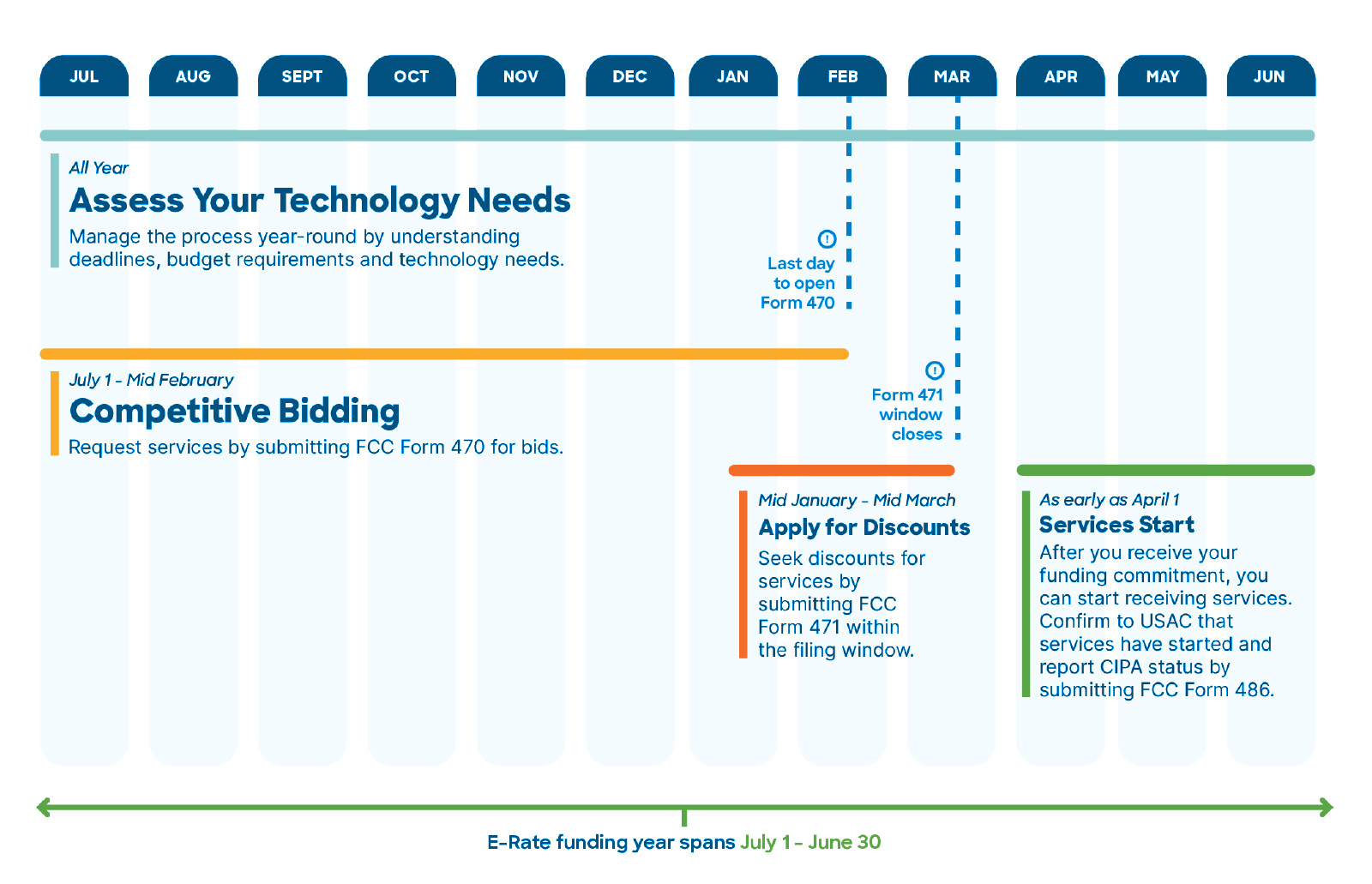
The E-Rate cycle officially began July 1, 2025, with the opening of the FCC Form 470 tool. This marks the start of the competitive bidding process. To request Category Two funding, Tribal schools and libraries must file Form 470, allow for a 28-day competitive bidding period, select a service provider, and then file Form 471 during the application window, expected to run mid-January through late-March 2026.
Click image to enlarge
Applicants must ensure they have designated themselves as “Tribal” in the E-Rate Productivity Center (EPC) to access relevant outreach, correct discount levels, and eligibility tracking.
Funding Floors and Discount Rates: What’s New in FY2026
The FCC’s July 2023 Report and Order reaffirmed an increased Category Two minimum funding floor of $66,385 for Tribal libraries, with a maximum discount rate of 90%. In addition, inflation adjustments for FY2026 through FY2030 increased Category Two multipliers by 20.7%. These adjustments provide substantial capacity to fund internal connections like switches, access points, and cabling.
For small projects, the competitive bidding exemption remains available: any internal connections request under $3,600 pre-discount per site is exempt from Form 470 bidding.
Explore More About Tribal E-rate
Want to go further? Learn how E-rate empowers Tribal schools and libraries to bridge connectivity gaps. Whether you need the complete program details or insights tailored specifically for libraries, these resources will guide your next step.
Tribal College and University (TCU) Libraries: Clarified Eligibility
TCU libraries may participate in the E-Rate program if they meet three conditions: they must have a dedicated public service role, be staffed by library personnel, and maintain a publicly accessible collection. Shared infrastructure between eligible and non-eligible areas must be cost-allocated, but the library portion remains eligible for support.
Strategic Planning: Making the Most of the FY2026 Cycle
To maximize E-Rate funding, Tribal entities should take proactive steps throughout the application cycle. Key strategies include:
- Begin Form 470 procurement planning early to meet the 28-day bidding period.
- Enroll in T-LEAP immediately to receive customized training and application support.
- Use the inflation-adjusted Category Two budget floor to upgrade or expand internal broadband infrastructure.
- Leverage the $3,600 small-purchase exemption to avoid unnecessary bidding complexity for minor upgrades.
- Consider consortium models, where a Tribal government or organization applies on behalf of multiple eligible entities.
A Turning Point in Tribal Connectivity
FY2026 represents a critical moment for Tribal E-Rate stakeholders. With higher funding ceilings, accessible application pathways, and proactive support through T-LEAP, the groundwork is in place to advance long-standing connectivity goals across Indian Country. Whether seeking to modernize library networks or deliver high-speed broadband to K–12 students, Tribal applicants now have a funding strategy tailored to meet their distinct challenges and aspirations.
E-Rate remains one of the most powerful tools to promote digital equity. For Tribal Nations, FY2026 is the time to plan smartly, apply boldly, and invest wisely in infrastructure that empowers education and preserves sovereignty.
Strengthen Tribal Connectivity for the Future
Start Now. Plan Smart. Empower Your Community.
Tribal schools and libraries have never had more support or more to gain from the E-Rate program. With increased funding floors, streamlined processes, and the dedicated T-LEAP program in place, FY2026 is your moment to close long-standing digital gaps and future-proof your infrastructure.
- Access up to $66,385 in Category Two funding
- Simplify your path with the $3,600 small-purchase exemption
- File early to stay ahead of the competitive bidding window
Unlock E-rate Funding to Power School & Library Connectivity
Discover how schools and libraries can maximize their C2 budgets, streamline applications, and plan strategically for the 2026–2030 funding cycle.
Read the Blog