
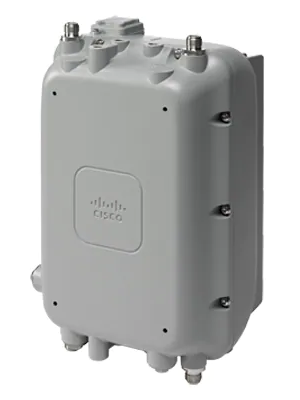
Cisco Aironet 1572EC Outdoor Access Point
External antenna with cable modem model
Notice: Discontinued Product
This unit has been discontinued and is no longer available for purchase. Please contact us for a replacement.
End of Sale (EOL): November 13, 2020
End of Support (EOS): November 30, 2025
For customers with active and paid service and support contracts, support will be available under the terms and conditions of customers' service contract.
Overview:
Highest-performing outdoor wireless access point
The Cisco Aironet 1570 Series outdoor access point is ideal for both enterprise and carrier-class network operators looking to extend Wi-Fi coverage outdoors. It’s the industry’s highest-performing outdoor AP and supports the latest Wi-Fi standard, 802.11ac, with data connection speeds up to 1.3 Gbps. This industrial-grade AP supports 4x4 Multiple-Input and Multiple-Output (MIMO) smart antenna technology and three spatial streams for optimum performance.
The Aironet 1570 provides higher throughput over a larger area with more pervasive coverage. The AP is also well suited to high-density environments w here many users in close proximity generate RF interference that needs to be managed. Examples of environments that can benefit from the Aironet 1570 Series:
- Outdoor enterprise campuses
- Outdoor university and school campuses
- Public venues: stadiums, train stations, airports
- Service provider networks: Wi-Fi offload for mobile, fixed-line, and cable operators
- Mining operations
- Manufacturing yards
- Municipalities
- Large metropolitan areas
 Next-Generation Outdoor Wireless Access Points
- Most advanced carrier-grade outdoor Wi-Fi AP
- 802.11ac dual-band (2.4 and 5 GHz) radios
- Maximum radiated RF power allowed by law
- Industry’s only 4x4, 3-spatial-stream outdoor AP
- 1.3 Gbps (5 GHz) WLAN RF data rates
- Cisco Flexible Antenna Port technology
- Uplink: Fiber/SFP, GE, Cable Modem
- DOCSIS3.0 with 24x8 channel bonding
- Power: AC, DC, Cable, UPOE, PoE-Out (802.3at)
- 4G LTE coexistence
- Module option: Investment protection and future proofing
- Low visual profile design
- Controller-based or standalone operation
- Cisco Aironet 1572EAC
- External antenna with AC-power model
- Cisco Aironet 1572IC
- Internal antennas with cable modem model
- Cisco Aironet 1572EC
- External antenna with cable modem model

Get assured wireless performance and location services
Cisco DNA software subscriptions provide analytics and assurance powered by AI/ML, for easy troubleshooting and management of your wireless network. Cisco DNA Spaces provides insights about people and assets on your premises and can help inform business decisions.
Features and Benefits:
The Cisco Aironet 1570 Series meets the demanding needs of customers across a broad range of industries spanning enterprises and service providers. It offers a scalable and secure mesh architecture for high-performance Wi-Fi services. It also addresses the expanding demand for Wi-Fi access services, network-to-network mobility, video surveillance, and cellular data offload to Wi-Fi.
The Cisco 1570 builds and expands on the successful 1550 series legacy of being the Wi-Fi outdoor AP of choice by service providers needing carrier-grade, ruggedized devices that are easy to deploy and maintain.
| Feature | Benefit |
| 802.11ac support with 4x4 MIMO, three spatial streams | Delivers higher data rates over a greater area with pervasive coverage than any competing AP. Provides a data rate of up to 1.3 Gbps, roughly triple the rates offered by today’s high-end 802.11n access points. |
| Maximum RF radiated power allowable on both 2.4 and 5 GHz radios | Lets you use the fewest number of APs to get the greatest possible area coverage and highest throughput rates. |
| Cisco High-Density Experience (HDX) | Helps maintain network performance as Wi-Fi clients, APs, and high-bandwidth applications join and roam the network. |
| Cisco CleanAir Technology | Provides spectrum intelligence across 20-, 40-, and 80-MHz channels to combat performance problems caused by wireless interference. Also part of Cisco HDX technology. |
| Cisco ClientLink 3.0 | Uses true beamforming smart-antenna technology to improve downlink performance by up to 6 dB to all mobile dev ices, including one-, two-, and three-spatial-stream devices on 802.11ac. Increases smartphone and tablet battery efficiency by up to 50 percent. Part of Cisco HDX technology. |
| MIMO equalization | Boosts performance and reliability by reducing the impact of signal fade and associated “dead zones”. |
| Cisco Flexible Antenna Port technology | Makes the AP’s external antenna ports software-configurable for either four dual-band (2.4 and 5 GHz) configuration or two pairs of single-band configuration with one pair operating at 2.4 GHz and the other at 5 GHz. This provides the operator with added flexibility in coverage options. |
| Modular architecture design | The architecture of the 1572E models provides the flexibility for a potential add-on module for future proofing and investment protection. For example, you could add external modules with technology options such as a 4G LTE picocell or a sensor. Such a module could be field-upgradeable to an existing 1570 network. |
| GPS support | Keeps track of the location of all outdoor APs deployed. With a built -in GPS receiver, the coordinates of the AP can be located by your WLAN controller or management system. |
| Central management using Cisco Prime Infrastructure | Network lifecycle management tool that integrates with Cisco Aironet APs and WLAN controllers to configure and manage y our wireless networks. Helps prevent costly maintenance service calls to outdoor locations. Network administrators have a single solution for RF prediction, policy provisioning, network optimization, troubleshooting, security monitoring, and WLAN system management. |
Technical Specifications:
|
Item |
Specification |
||||||||
|
Part numbers |
|
||||||||
|
802.11n Version 2.0 capabilities |
|
||||||||
|
802.11ac Wave 1 capabilities |
|
||||||||
|
DOCSIS 3.0 Capabilities |
|
||||||||
|
Data rates supported |
2.4 GHz - 802.11b/g: 1, 2, 5.5, 6, 9, 11, 12, 18, 24, 36, 48, and 54 Mbps | ||||||||
| 2.4 GHz - 802.11n: | |||||||||
|
Spatial Streams |
MCS Index1 |
GI2 = 800 ns |
GI = 400 ns |
||||||
|
20-MHz Rate (Mbps) |
20-MHz Rate (Mbps) |
||||||||
|
1 |
0 |
6.5 |
7.2 |
||||||
|
1 |
1 |
13 |
14.4 |
||||||
|
1 |
2 |
19.5 |
21.7 |
||||||
|
1 |
3 |
26 |
28.9 |
||||||
|
1 |
4 |
39 |
43.3 |
||||||
|
1 |
5 |
52 |
57.8 |
||||||
|
1 |
6 |
58.5 |
65 |
||||||
|
1 |
7 |
65 |
72.2 |
||||||
|
2 |
8 |
13 |
14.4 |
||||||
|
2 |
9 |
26 |
28.9 |
||||||
|
2 |
10 |
39 |
43.3 |
||||||
|
2 |
11 |
52 |
57.8 |
||||||
|
2 |
12 |
78 |
86.7 |
||||||
|
2 |
13 |
104 |
115.6 |
||||||
|
2 |
14 |
117 |
130 |
||||||
|
2 |
15 |
130 |
144.4 |
||||||
|
3 |
16 |
19.5 |
21.7 |
||||||
|
3 |
17 |
39 |
43.3 |
||||||
|
3 |
18 |
58.5 |
65 |
||||||
|
3 |
19 |
78 |
86.7 |
||||||
|
3 |
20 |
117 |
130 |
||||||
|
3 |
21 |
156 |
173.3 |
||||||
|
3 |
22 |
175.5 |
195 |
||||||
|
3 |
23 |
195 |
216.7 |
||||||
|
|
802.11ac data rates on 5 GHz: |
||||||||
|
MCS Index |
Spatial Streams |
GI = 800 ns |
GI = 400 ns |
||||||
|
20-MHz Rate (Mbps) |
40-MHz Rate (Mbps) |
80-MHz Rate (Mbps) |
20-MHz Rate (Mbps) |
40-MHz Rate (Mbps) |
80-MHz Rate (Mbps) |
||||
|
0 |
1 |
6.5 |
13.5 |
29.3 |
7.2 |
15 |
32.5 |
||
|
1 |
1 |
13 |
27 |
58.5 |
14.4 |
30 |
65 |
||
|
2 |
1 |
19.5 |
40.5 |
87.8 |
21.7 |
45 |
97.5 |
||
|
3 |
1 |
26 |
54 |
117 |
28.9 |
60 |
130 |
||
|
4 |
1 |
39 |
81 |
175.5 |
43.3 |
90 |
195 |
||
|
5 |
1 |
52 |
108 |
234 |
57.8 |
120 |
260 |
||
|
6 |
1 |
58.5 |
121.5 |
263.3 |
65 |
135 |
292.5 |
||
|
7 |
1 |
65 |
135 |
292.5 |
72.2 |
150 |
325 |
||
|
8 |
1 |
78 |
162 |
351 |
86.7 |
180 |
390 |
||
|
9 |
1 |
– |
180 |
390 |
– |
200 |
433.3 |
||
|
0 |
2 |
13 |
27 |
58.5 |
14.4 |
30 |
65 |
||
|
1 |
2 |
26 |
54 |
117 |
28.9 |
60 |
130 |
||
|
2 |
2 |
39 |
81 |
175.5 |
43.3 |
90 |
195 |
||
|
3 |
2 |
52 |
108 |
234 |
57.8 |
120 |
260 |
||
|
4 |
2 |
78 |
162 |
351 |
86.7 |
180 |
390 |
||
|
5 |
2 |
104 |
216 |
468 |
115.6 |
240 |
520 |
||
|
6 |
2 |
117 |
243 |
526.5 |
130 |
270 |
585 |
||
|
7 |
2 |
130 |
270 |
585 |
144.4 |
300 |
650 |
||
|
8 |
2 |
156 |
324 |
702 |
173.3 |
360 |
780 |
||
|
9 |
2 |
– |
360 |
780 |
– |
400 |
866.7 |
||
|
0 |
3 |
19.5 |
40.5 |
87.8 | 21.7 | 45 | 97.5 | ||
|
1 |
3 |
39 |
81 |
175.5 | 43.3 | 90 | 195 | ||
|
2 |
3 |
58.5 |
121.5 |
263.3 | 65 | 135 | 292.5 | ||
|
3 |
3 |
78 |
162 |
351 | 86.7 | 180 | 390 | ||
|
4 |
3 |
117 |
243 |
526.5 | 130 | 270 | 585 | ||
|
5 |
3 |
156 |
324 |
702 | 173.3 | 360 | 780 | ||
|
6 |
3 |
175.5 |
364.5 |
- | 195 | 405 | - | ||
|
7 |
3 |
195 |
450 |
877.5 | 216.7 | 450 | 975 | ||
|
8 |
3 |
234 |
486 |
1053 | 260 | 540 | 1170 | ||
|
9 |
3 |
260 |
540 |
1170 | 288.9 | 600 | 1300 | ||
|
Maximum number of non-overlapping channels |
A (A regulatory domain):
B (B regulatory domain):
C (C regulatory domain):
D (D regulatory domain):
E (E regulatory domain):
F (F regulatory domain):
H (H regulatory domain):
I (I regulatory domain):
|
K (K regulatory domain):
M (M regulatory domain):
N (N regulatory domain):
Q (Q regulatory domain):
R (R regulatory domain):
S (S regulatory domain):
T (T regulatory domain):
Z (Z regulatory domain):
|
|||||||
|
Note: This varies by regulatory domain. Refer to the product documentation for specific details for each regulatory domain. |
|||||||||
| Maximum Number of Non-overlapping Channels | 2.4 GHz
|
5 GHz
|
|||||||
| Maximum Conducted Transmit Power | 2.4 GHz
|
5 GHz
|
|||||||
|
Note: The maximum power setting will vary by channel and according to individual country regulations. Refer to the product documentation for specific details. |
|||||||||
| Interface |
|
||||||||
| Uplink options |
|
||||||||
|
Dimensions (W x L x H) |
|
||||||||
|
Weight |
|
||||||||
| Environmental |
|
||||||||
| Environmental Ratings |
|
||||||||
| Antennas |
|
||||||||
| Powering options | 1572EAC
|
1572IC/1572EC
|
|||||||
|
Power draw |
Kensington lock slot to lock device to mounting bracket | ||||||||
|
Physical security |
Included with the access point: mounting bracket AIR-AP-BRACKET-NS or AIR-MOD-AC-XX | ||||||||
|
Mounting |
|
||||||||
| Compliance |
|
||||||||
| Configuration Options | Flexible deployment configurations include:
|
||||||||
| Warranty |
1-year limited hardware warranty |
||||||||
Transmit Power and Receive Sensitivity:
| Receive Sensitivity | ||||
|---|---|---|---|---|
| 2.4 GH 802.11, 802.11b (DSSS, CCK) -103 dBm @ 1 Mbps -101 dBm @ 2 Mbps -93 dBm @ 5.5 Mbps -90 dBm @ 11 Mbps |
2.4 GHz 802.11g (non HT20) -93 dBm @ 6 Mbps -93 dBm @ 9 Mbps -93 dBm @ 12 Mbps -92 dBm @ 18 Mbps -89 dBm @ 24 Mbps -87 dBm @ 36 Mbps -82 dBm @ 48 Mbps -81 dBm @ 54 Mbps |
5 GHz 802.11a (non HT20) -92 dBm @ 6 Mbps -92 dBm @ 9 Mbps -92 dBm @ 12 Mbps -91 dBm @ 18 Mbps -89 dBm @ 24 Mbps -86 dBm @ 36 Mbps -81 dBm @ 48 Mbps -80 dBm @ 54 Mbps |
||
| 2.4-GHz 802.11n (HT20) -93 dBm @ MCS0 -93 dBm @ MCS1 -91 dBm @ MCS2 -88 dBm @ MCS3 -85 dBm @ MCS4 -80 dBm @ MCS5 -79 dBm @ MCS6 -78 dBm @ MCS7 -93 dBm @ MCS8 -91 dBm @ MCS9 -89 dBm @ MCS10 -86 dBm @ MCS11 -82 dBm @ MCS12 -78 dBm @ MCS13 -77 dBm @ MCS14 -76 dBm @ MCS15 -93 dBm @ MCS16 -90 dBm @ MCS17 -88 dBm @ MCS18 -84 dBm @ MCS19 -81 dBm @ MCS20 -77 dBm @ MCS21 -75 dBm @ MCS22 -74 dBm @ MCS23 |
5-GHz 802.11n (HT20) -92 dBm @ MCS0 -91 dBm @ MCS1 -90 dBm @ MCS2 -87 dBm @ MCS3 -84 dBm @ MCS4 -79 dBm @ MCS5 -78 dBm @ MCS6 -77 dBm @ MCS7 -92 dBm @ MCS8 -90 dBm @ MCS9 -87 dBm @ MCS10 -85 dBm @ MCS11 -81 dBm @ MCS12 -77 dBm @ MCS13 -76 dBm @ MCS14 -74 dBm @ MCS15 -91 dBm @ MCS16 -89 dBm @ MCS17 -87 dBm @ MCS18 -84 dBm @ MCS19 -80 dBm @ MCS20 -76 dBm @ MCS21 -75 dBm @ MCS22 -73 dBm @ MCS23 |
5-GHz 802.11n (HT40) -88 dBm @ MCS0 -88 dBm @ MCS1 -87 dBm @ MCS2 -84 dBm @ MCS3 -81 dBm @ MCS4 -76 dBm @ MCS5 -75 dBm @ MCS6 -74 dBm @ MCS7 -89 dBm @ MCS8 -87 dBm @ MCS9 -85 dBm @ MCS10 -82 dBm @ MCS11 -79 dBm @ MCS12 -74 dBm @ MCS13 -73 dBm @ MCS14 -71 dBm @ MCS15 -88 dBm @ MCS16 -86 dBm @ MCS17 -84 dBm @ MCS18 -80 dBm @ MCS19 -78 dBm @ MCS20 -73 dBm @ MCS21 -71 dBm @ MCS22 -70 dBm @ MCS23 |
||
| 5 GHz Radio | ||||
| Spatial streams | MCS Index | 802.11ac (VHT20) | 802.11ac (VHT40) | 802.11ac (VHT80) |
| 1 | 0 | -92 | -89 | -85 |
| 1 | 4 | -86 | -83 | -80 |
| 1 | 7 | -79 | -75 | -73 |
| 1 | 8 | -74 | -71 | -68 |
| 1 | 9 | NA | -69 | -66 |
| 2 | 0 | -92 | -89 | -85 |
| 2 | 4 | -83 | -81 | -77 |
| 2 | 7 | -76 | -74 | -70 |
| 2 | 8 | -72 | -68 | -66 |
| 2 | 9 | -NA | -67 | -63 |
| 3 | 0 | -91 | -89 | -85 |
| 3 | 4 | -82 | -79 | -76 |
| 3 | 7 | -75 | -72 | -69 |
| 3 | 8 | -69 | -66 | -64 |
| 3 | 9 | -66 | -64 | -60 |
Documentation:
Download the Cisco Aironet 1570 Series Outdoor Access Point Datasheet (PDF).
Pricing Notes:
- Pricing and product availability subject to change without notice.